
Upping Your Game
The Required Equipment
Players
Afterverse is recommended for 4-7 players: one Game Master and 3-6 players. It is possible to play with different numbers of players, but requires special considerations. Games with more players tend to require special attention to ensure the game keeps moving and that all players stay engaged with the story and the action; games with fewer players require a more in-depth exploration of their own characters.
Large Gaming Groups
Games with a full-size group (or even larger) have a strong tendency to drag out while each player takes their time, makes decisions, and make the appropriate dice rolls while everyone else waits. This is especially true in combat, but unfortunately, large gaming groups tend to focus so little on character development that large-group combat ends up being the most interesting part of the game. For this reason, gamemasters of large groups are encouraged to be particularly strident when it comes time to keep the battle moving. Giving players an absolute time limit of 5 or 10 seconds to make a decision as to what to do with their turn may be the most effective strategy–the players still have more time after deciding to roll the necessary dice, but they must be paying enough attention to know what they want to do immediately when their turn comes up.
Additionally, the logistics of keeping track of the battle become crucial. Keeping track of the Initiative and status of each enemy secretly and conveying this information to the players when they make observation tests, as the rules-as-written would dictate, may prove too cumbersome in such a large battle. It may be better to keep most of this information out in the open for the players to see without needing to ask.
Dice

The Game Master and each player will need sets of 6-sided dice. We recommend approximately 12-18 dice per player. Dice sets like this may be found at game stores or online; we recommend sets of small dice (such as the 8mm dice seen here), as they're easier to roll in large numbers, in addition to being more affordable in large quantities.
Character Sheets
You will need one sheet per character. The character sheet is available for free download on the website for your players to create their own characters. Alternately, you may use pregenerated characters–but whatever the source, you will need character sheets. They hold Attributes, Qualities, Skills, and so on that players will need to reference on a regular basis.
Starship Sheet
If your characters comprise the crew of one or more spacecraft, the Starship Sheet is a handy way to keep track of the status of the crew and the ship. The Starship Sheet has space to fill in the System Table of the vessel, the most commonly needed dice pools for the relevant characters, and spaces to put either counters or dice to store the value of the Banks.
Action Cards (Optional)
Action Cards
Afterverse supports a deck of Action Cards, which hold quick reference guides for rules in addition to a convenient place to store hit banks. Though this is not necessary, most players find the cards helpful to keep track of their character, their status, and their available actions. The Action Cards may be purchased online, and a free print-and-play version of the cards will be available on the Afterverse website.
For supplementary downloads and links, please see the website
https://www.afterver.se
Counters
Afterverse uses hit banks, whose value will fluctuate frequently, and counters are a good way to keep track of these. Approximately 30 counters are recommended per player, representing the highest bank value. Alternately, your players may use something erasable (for example, dry erase boards or laminated sheets) to keep track of banks. In any case, you will need the ability to track multiple changing values for banks.
Your First Game Session
Unless you're playing a prebuilt one-off adventure, the first time you gather to play Afterverse will, more often than not, be a session to determine the direction of the campaign. Before you begin, you as a GM should guide the players to make a decision as to which era and what kind of adventure the players would most enjoy to be a part of.
There are a wide variety of adventures available in Afterverse, and it can be daunting to pick one-especially if you're not already intimately familiar with the lore and history of the world. Here are some hints that may help narrow it down. Once you've decided on an era, reading that era's History chapter should be sufficient to get players up to speed on the world–each History chapter begins with a fictional, in-universe story from that era, followed by a section titled "The Story of the Age" which will summarize the history prior to that era and provide enough context to play the game.
The Fandom Method
Fandom
A good first step is to simply go around the group and ask about their favorite sci-fi shows, movies, or books. Afterverse is an expansive world with many influences, and among its many settings, it's possible to create game scenarios and plotlines that are reminiscent of many different other sci-fi stories. Here are some comparable adventures to get your group started.
| Influence | Era | Adventures |
|---|---|---|
| Star Trek: Enterprise | Expansion Era | The Early ESF |
| ST: The Next Generation | Orion War | (any) |
| ST: Deep Space 9 | Expansion Era | Hyperion Station (The Moons of Saturn) |
| ST: Voyager | Fall of the Fleet* | |
| Babylon 5 | Artifact Era | Parella Station (Unification Charter, Parella Station Defiant) |
| Star Wars | War of the Chosen* | |
| Stargate | Artifact Era | The Artifact Hunts |
| Shadowrun | Occupation Era | Covert Ops, Collaborators, UU resistance |
| Firefly | Expansion Era | The Moons of Saturn |
| Battlestar Galactica | Fall of the Fleet* | |
| The Expanse | Expansion Era | EGF |
* Some of these adventures are not part of the core sourcebook, and will be upcoming in a future supplement.
Character Creation
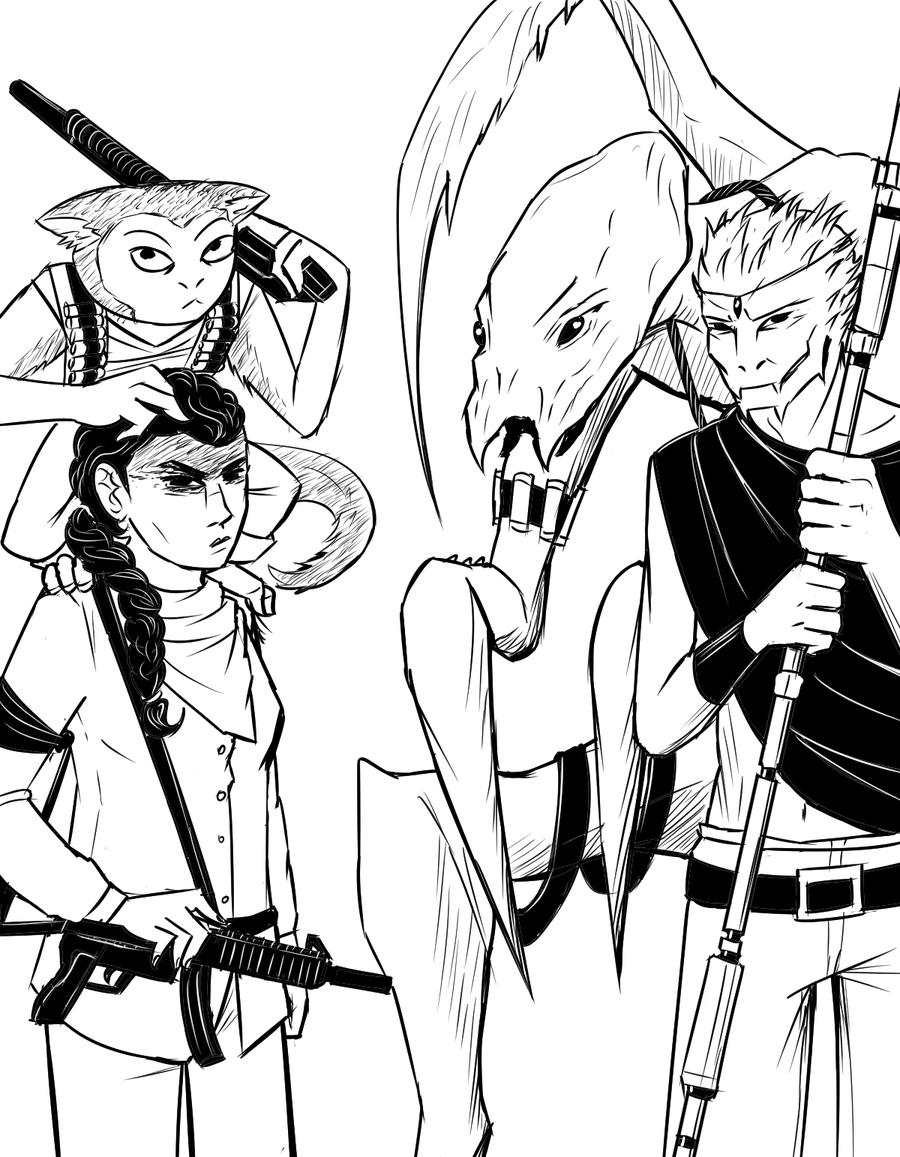
Once you have chosen your adventure setting, it will generally be time to create characters. For this, following the guidelines in the character creation chapter will guide most of your decisions. A few other considerations are described here.
The Spock Rule
In the original Star Trek series, Spock was the sole alien on a crew of humans. By and large, this is a good guideline, not so much in the number of alien characters but in the area of weirdness: every gaming party benefits from having one weird character, but more than that has a tendency to make the campaign's story disjointed, obnoxious, and nonsensical.
Party Leadership
You must decide as a group whether or not you want one player to be a team leader. Not all players are capable of leading a group of players without ruining the game for the other players, and if no player has the roleplaying experience to suit this role, it's a good idea to avoid having a team leader at all. The player acting as team leader should be an experienced roleplayer who is prepared to actively work to make the gaming experience for other players better. (See also "O Captain My Captain" on the online edition for more ideas on handling leadership roles.)
Game Logistics
Winging It
The single most important piece of logistical advice for Afterverse is this; if no one can remember the rule, just wing it. Nothing brings a game to a halt like digging through a sourcebook. The system is designed to be mostly internally consistent and have fairly predictable rules, so once you've got the basics of the system, you should be able to extrapolate the edge cases and arrive at a fair conclusion without needing to reference the precise rule. The same goes for rules that don't exist in the book, simply because not every single scenario can be predicted. No rules for how the character plays roulette? Just have the player roll some dice and see what happens.
You can make a note of the improvised rule and look up the book-accurate rule after the game to better prepare for future sessions.
Bank-Tracking Advice
Gameplay in Afterverse (especially combat) is designed with counters in mind. To avoid large amounts of writing, calculating, storing numbers, and erasing when tracking initiative, using a die or some sort of token to track these banks is recommended. Poker chips, game counters, or pennies work well for this. When a player is planning his turn, he can shift tokens around to establish how many points he is using; after he acts, he removes those tokens from his bank; he draws new tokens into his bank when new initiative is rolled. There are a number of banks that may be tracked effectively using counters – Initiative, Physical, Stun, Chutzpah, Ammo, Blitz, and Recoil on the character itself, and vehicles and cores have their own banks as well. (In order to prevent the mixing of piles, either use a stackable counter like poker chips, or use different colored counters for each pile.) It can also be helpful to track XP as a bank over the course of a session, adding it to the character sheet at the end of the session.
Depending on the situation, it may be preferable to use different types of counters. A more compact "travel kit" for Afterverse might include laminated sheets/cards with dry erase markers, for example. Any bank-tracking system is valid; all it needs is the ability to track multiple changing numbers. Counters/tokens are simply recommended for the feel and tangibility.
Alternative Game Styles
One-off Adventures
Afterverse is primarily designed to be run in continuing campaigns, and some gameplay elements don't work as well if playing just a single session (for example, at a gaming convention).
While earning XP is a major goal for ongoing campaigns and serves as an effective means to encourage players to roleplay their Motivations, a single game session is unlikely to be affected by the amount of XP earned. To compensate, you may allow players in such a game to spend their XP to gain a bonus to a test. For example, perhaps players can spend 1 XP to add 2 dice to any roll. Alternately, they could spend 3 XP to use one Chutzpah power. (Using 1 XP for Chutzpah powers is not recommended, as it would give many players several times more Chutzpah over the course of the game session than the game is designed for.) Establish any reward system you prefer at the start of the session.
The Characters' Story
The kind of stories that will work for your gaming group depend heavily on the group's binding principle. Though this can take any number of permutations, there are three major kinds; military, independent, and criminal. Some groups, of course, don't fit neatly into these categories, but in terms of the kinds of plots available, they tend to fall under some umbrella or another.
The Party as Both Ship and Ground Crew
The typical space opera setup follows a captain and his crew, who will tend to be the ones both flying the ship in combat situations and conducting all the missions on the ground, no matter the situation. This trope is a standard for a reason, as it's easy to create stories involving the entire party. Thus, this option is convenient for storytelling and character building, and if this is a story style that appeals to your group, then by all means employ it. That said, it is wildly unrealistic from a strategic standpoint in most situations, and may compromise immersion into the game world. Following are some strategies for telling these kinds of stories.
The Party as a Military Unit
Many campaigns will have the players serving as the part of a military. In these games, it is challenging and yet important to ensure that the players are given a variety of missions, while still keeping them together as a group. Most plots will put the player characters on the crew of the same ship or station, and this advice is written with that situation in mind.
O Captain My Captain?
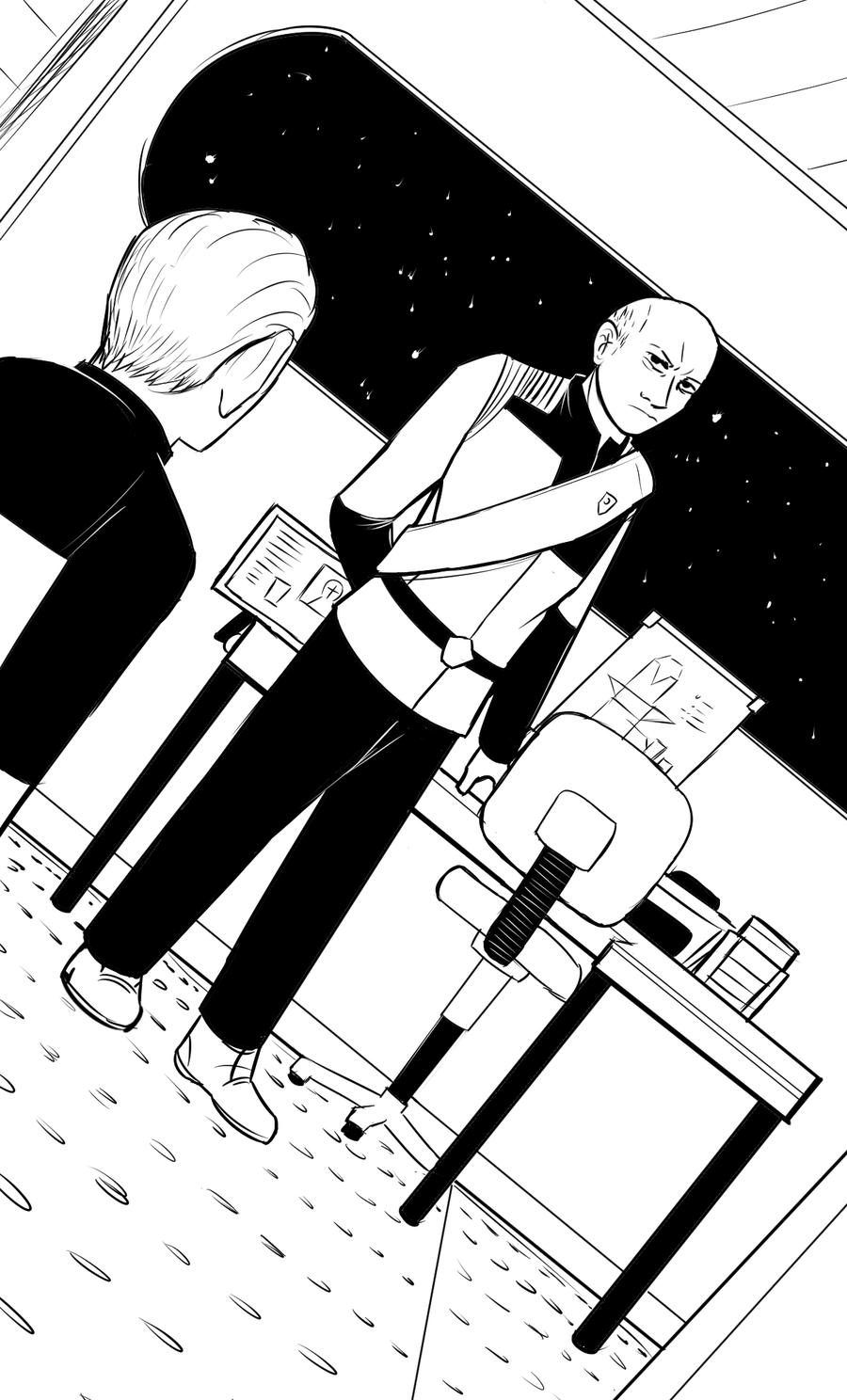
You may want to give special consideration to how to handle a ship's captain in a story. There are many ways to handle it, and the best way will be different for every gaming group.
One reason to avoid a player as captain in many cases is that the Captain stays with the ship. In most militaries, it is bad policy for the ship's captain to leave the ship to go on away missions, to explore planets or engage the enemy on foot. If you expect to have any of these types of missions in your game, you may want to have the Captain played as an NPC so that that player is not twiddling their thumbs for the entirety of the mission. An alternative solution might be to allow that player a second character to play during away missions.
Player Character Captain
It's often poor game group policy to have one character be the "star", and it's tough for the captain to share the spotlight. Other players may start to feel ignored. If this concern does not apply to your gaming group–for example, maybe you have one player that everyone really enjoys watching take the spotlight, or conversely, one player who is skilled at working with the GM to ensure that the spotlight is shared–then the captain's seat should be available to your players.
If you wish to have a player act as the captain, be certain that this player is an experienced roleplayer and is familiar with the universe. Few things can grind the story to a halt like the entire table looking over to a newbie playing the Captain for orders, only to have them shrug or ask the GM what he should do.
NPC Captain
If the GM chooses to run the captain as an NPC, it may feel to the players as if they have no control over the story–they'll be just carrying out the GM's orders to go up against obstacles that are sent against them by the GM, which is rarely a fun game setup. It can be made to work with the proper story setup, though. If your captain is more hands off, only stepping in to give orders when absolutely necessary, the first mate (played by a player) may have more autonomy and freedom to perform missions, while not having quite as much elevation over the rest of the crew, so they won't be as much of a liability in terms of hogging the spotlight.
Democratic Captain
An explicitly democratic captain may solve the player agency issue of the NPC Captain. When faced with any decision, the NPC captain will call his senior staff to his ready room for input, and following the discussion, the GM has the players vote on the captain's orders. The downside of this method is that it has a way of making the captain be a tool of the party and not a character, but the tradeoff might be worth it.
Command Token Captain
This method is similar to the democratic captain, except that it allows a little more variety and decisiveness. At the beginning of the game session, the GM hands each player an "command token" (a counter, card, or pretty much anything). At any point, a player may hand in his command token to choose which order the captain will give; at other points, the captain is played as an NPC.
Advance Crew
(See also the online edition.)
One plausible method to meeting all the standard storytelling requirements without sacrificing plausibility, especially if there is expected to be a focus on "in-person" missions over ship-to-ship combat, is to have the player characters play an "advance crew". If the starship has a mission to accomplish across the solar system, it may have to get there faster than its finite fuel reserves would allow, lest the ship become stranded there. The idea of an advance crew is that they can take a shuttle or transport and burn at the maximum possible speed. The shuttle can arrive much faster than the large ship and burn through nearly its entire fuel supply; though it will be technically stranded, the mothership will be on its way at its own (slower) speed.
This crew structure will allow the player characters to function independently of the rest of the crew, to have personal adventures without a large crew to complicate storylines, and generally be the heroes. It allows for large scale space battles at the climactic moment when the mothership arrives, and the party might be put in a position of strategic importance when the mothership is coming into a dangerous situation. It has the added benefit of being a realistic strategy in hard science fiction. The downside is that it may be difficult to get the players into ship combat roles on the mothership when the big battles come–advance crews have only their little (usually unarmed) transport with them, so any space combat that happens will probably be more about guile, strategy, and resourcefulness, using their little unarmed ship to greatest advantage (or simply running for their lives as the mothership nukes the target from orbit).
The Party as an Independent Group
If your players prefer a uniform that looks a little more like a brown coat, they have a little more freedom in their play style. Independent campaigns tend to be freeform, episodic game sessions. Unlike military campaigns, it makes perfect sense for the captain to join away teams (often consisting of the entire crew of their little smuggler's ship, or whatever they have), although this may be replaced with the similar problem that the pilot will probably be asked to remain on the ship in tense situations to prepare for a quick getaway.
An independent crew might find any number of jobs to keep their ship flying. Transporting people or cargo is fairly straightforward work, and as such, does not compose a good (complete) story; augment such straightforward work by making the people problematic, or the cargo overly valuable, making the transport a target for pirates. If the cargo is contraband, then law enforcement might like to have a word with you. If it's stolen, the original owner might. Transporting stolen cargo is not the only thing to do with a ship, of course; you could use it to steal the item in the first place.
Your ship of independents may be law abiding, or criminals, or they may simply take whatever job they can get. Transport missions, extractions, robberies, and smuggling are all fair game for this kind of campaign. The one thing they have in common is money–there must almost always be a profit motive. The few exceptions will be when the crews' Motivations are in play, but since it's rare for entire crews to share the same Motivations, it's likely that some of the crew will have to be talked into these jobs.
Any number of people might need to hire a spaceship and crew for fighting purposes, whether as aggressor or defender, and whether for good or ill. You could well have your Human crew offered big money by an alien to fight against their own species. Your crew may have to make up their minds how to proceed with difficult moral decisions with regard to potential employers–which shade of gray is a shade too far?
Featured Contacts as Plot Devices
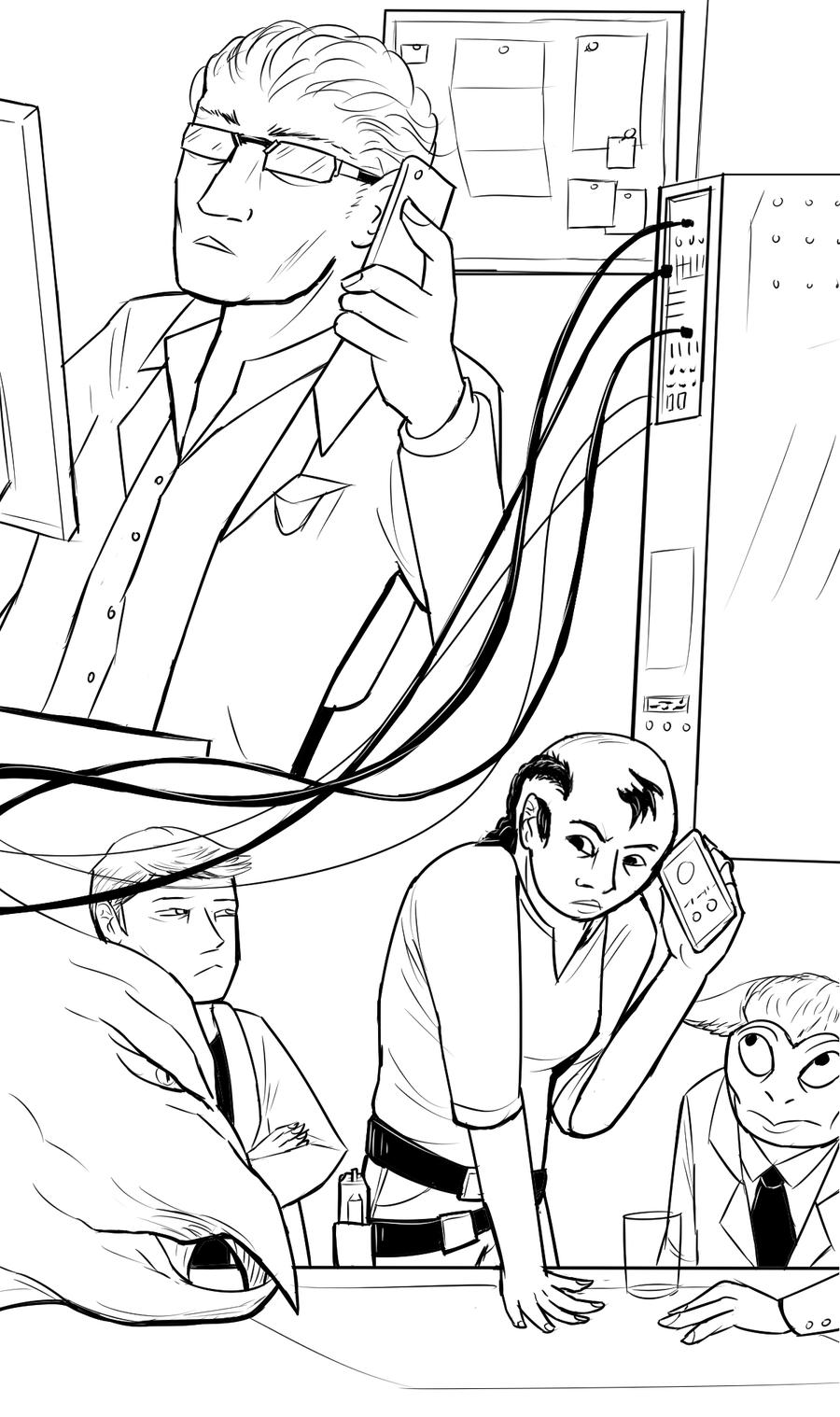
An independent party lives and dies by its contacts, which can and almost certainly will serve as the biggest source of plot hooks. For this reason, during character creation for independent parties, it's recommended that players create at least one featured contact from their Social Bank. Frequently they'll simply call with jobs on offer, and that can be a simple, straightforward mission–and early on, this is a good way to easily kickstart a plot.
But the more rare exceptions to these are the change of pace that keeps campaigns lively. A contact might ask for a personal favor rather than a job. If the players have asked the contact for something recently, they might only oblige after the players do a favor for them. Maybe a contact has gone missing, or the crew gets a message from a stranger demanding a ransom for the contact. Perhaps a contact will fail to respond to the crew's request for aid at the worst possible time, suggesting an investigation is in order. Maybe the arms dealer goes silent just when they were due to deliver a huge new weapon to the crew, and the crew has to determine whether they've been betrayed, or if their contact is in trouble.
Using featured contacts like this is generally only effective if the players have an emotional connection to these contacts, so even if you've already got a strong plotline going, you'll want to make use of the party's contacts as much as you can, in order to plant the seeds for later.
The Criminal Element
While an independent crew may sometimes perform illegal acts, other crews will make such acts their cornerstone. In practice, a campaign centered around this kind of work will not be much different than a standard independent campaign, except for the addition of a lot more dodging of law enforcement.
Life on Station
There are a number of hubs throughout the systems in Afterverse where ships will come and go, potentially bringing plots with them. Life on a station relies much more heavily on established communities and, as a result, the contacts of the party take on much more importance.
If playing an independent crew in this scenario, the party may not need to work to keep their ship flying, though they'll still need to make rent. Still, this can be a good way to get a campaign started on a personal scale. As the party's assets increase, they might find themselves eventually able to buy a ship for themselves–indeed, for independent parties, this can be a good motivation in early game. As important as contacts are for independent crews in general, they're much more important on a station, especially since all of the party's contacts are likely to be nearby, and easily contacted.
There are plenty of jobs to keep a military-based party busy on a station, too. Many stations contract the military to keep an eye on traffic passing through and some of the smaller ones have the military handle policing tasks, too. Militaries themselves often assign a party on a station as insurance to handle any number of possible contingencies–such a situation allows the party to carry out business of their own freely, while still leaving room for the military to call them to action at any moment.
Single Sessions
A single session game has a number of differences from a campaign. Many of the systems of motivation built into the Afterverse system have little impact in a single-session game, so the story itself must be the driving force behind your players and characters. A good idea for single-session games is to focus on a more detailed, well-laid-out storyline than you might have with a longer campaign. Pregenerated characters are recommended, so as to minimize the unexpected variation from the story, and to make it easier to incorporate each character into the action.
Interludes
If your campaign is growing repetitive or wearing on the players, a break from the usual may be advisable. This may take the form of a story entirely unrelated to the main plot of your campaign, but another idea may be to create a side plot somehow related to the story. A new perspective on an existing storyline can breathe new life into the story and make the plot exciting again. Perhaps the interlude could focus on a different faction in the same conflict, or another team in the same faction (perhaps one that is not expected to survive, for added dramatic flair).
Alternately, the interlude could focus on a group in the past or the future to gain better insight into the particulars of the story. If one character in your party is noticeably older than the others, you might have that players play a younger version of the same character (possibly giving the other players a chance to be the older, more advanced characters); if one of your characters is particularly young, you may do the inverse.
One-Off Stories
A one-off story is a story for a group of players that may only be meeting once and never again. This is the kind of game session you might see in a setting such as a game store or a gaming convention. By and large, such a game session should have a stand-alone plot that is not dependent on any other ongoing storylines, and it should not depend on being familiar with the existing Afterverse canon.
A one-off story should have a clear mission definition and objective so that the story can begin moving immediately. Pregenerated characters are strongly recommended for such missions, ideally ones with a well-defined purpose, and a character bio and Motivations which are meant to enhance the storyline.
Most such sessions will have a set time block for playing the game, so it will be the GM's responsibility to move the plot along at an appropriate pace. If writing such an adventure, optional challenges should be included in case the party breezes through the adventures.
Creating a Welcoming Gaming Experience
Diverse Gaming Group
It's important when playing games of all kinds, especially roleplaying games, to ensure that no gamer feels like a second class citizen, and it's all too easy to inadvertently ignore behavior that does exactly this, or even fall into habits that directly perpetuate such behavior. Many kinds of people are underrepresented in the world of tabletop roleplaying, a few examples of which are gamers of color, transgender gamers, and women. While bad behavior towards other players is always discouraged, bad behavior towards these groups is particularly harmful to the community. A big part of the roleplaying experience is learning to view the world through different eyes, and this becomes much more difficult if the gamers you're surrounded with are similar to you, not just in appearance but in life experience.
If you find yourself reflected in the descriptions of bad behavior below, the solution is straightforward: strive to improve yourself, and learn to take criticism constructively. If someone else at the table tells you that you're making others uncomfortable, that person is your best friend in the room. Consider that, long before your behavior (whatever it may be) reached the threshold where someone felt the need to talk to you, you have certainly already been making people uncomfortable; the person with the problem is, invariably, the last to notice.
Defining bad behavior
In its most simple form, bad behavior in this situation is defined as behavior that makes other players feel unsafe or uncomfortable.
In this community, the most common such behavior by far is unwanted sexual advances directed towards women. In this context, it's helpful to define it as including all sexual advances. Don't hit on players at your table; it is virtually always unwanted, and always makes the receiver of such advances uncomfortable. If the person making the advance has trouble recognizing signs of a lack of interest, the receiver of the advances may feel unsafe as well as uncomfortable.
Condescension is another common behavior that makes people feel uncomfortable at the gaming table, and it is unfortunately common that this behavior is more often directed towards people at the table who don't "look like a gamer"–again, because these tend to be the people who are underrepresented in this community. It's an understandable impulse to assume that the people who look like you have similar expertise levels as you do, but it's a harmful impulse nonetheless.
A related behavior is gatekeeping, which is when someone decides that someone else is not worthy of respect on account of their level of expertise. A well-known example of gatekeeping is the accusation of "fake nerd girl", which is particularly damaging in that it never crosses the offender's mind that a "fake nerd guy" is equally probable. The rule of this community must be that anyone who chooses to be a nerd, is a true nerd; there is no faking it. More specifically, anyone who chooses to play Afterverse, is a true Afterverse fan. There is no need to test anyone, and there's no need to be competitive about it.
Handling Bad Behavior at the Table
Most bad behavior comes in small, persistent doses. As a result, virtually any action taken against the perpetrator is likely to be seen by some as an overreaction. Afterverse officially condones punitive actions for this kind of behavior even if they may be seen as overreactions.
If possible, for this kind of small but repeatable offense, sanctioning the offender without grinding the game to a halt may be desirable. A simple, straightforward, matter of fact statement is one approach: "You're acting creepy and making other people uncomfortable." If you're the kind of GM or player that utilizes notes at the table, a note passed to the offender may accomplish the same thing. GM's are permitted and encouraged to punish such offenders by taking away XP tokens, especially if the player has already been made aware of the reason why.
If you as a GM observe such behavior, the responsibility ultimately falls on you to ensure that players are treating each other with the proper respect.
Convention Policies
All official Afterverse games will have policies in effect in line with those described above. The precise set of policies will evolve over time. Thus, it's best to find these policies on the Afterverse website.