
Character Creation
Before you start - campaign setting
No character exists in a vacuum, and characters in Afterverse are affected directly by where and when they exist. Your gaming group and gamemaster should agree on a setting for the campaign —choose an era and adventure. The chosen setting will indicate which Culture(s) you may choose for your character, as well as what kind of character concepts the team will comprise.
Choose a Culture
(More information on how Cultures work in game is available in the One Among the Crowd chapter on One Among the Crowd; lists of available Cultures are in each Era in its History section.)
Every character must have a Culture. This can be either the Culture in which he grows up, or he may choose to renounce that Culture later for a different one. There are many times where different Cultures will interact and live in the same place at the same time—for example, Collaborators and Equator Slaves in the Occupation Era. Different Cultures interact with each other in many ways. Most of the time, Cultures have a mutual distrust and/or dislike of each other.
Cultures don’t cost any XP directly, but any requisite aspects of that Culture (Qualities, Skills, etc.) must be bought with XP as normal, and the Culture's listed Motivations must be taken, using Motivation points. While Motivations usually incur a Base Cost to take the first level, the levels required by the Culture do not incur this Base Cost unless the player chooses to raise the level of that Motivation beyond what is required. If a Culture has listed aspects of a character which are recommended but not required (for example, "many citizens know..."), then it is not considered a part of the requirements.
The primary direct benefit that a Culture provides is via its tech levels; more advanced gear is available in some Cultures than others. By and large, the higher the available Tech Levels, the more Skills will be required by that Culture to balance it (and the Skills may not always be relevant to a given character). No Culture has requirements that cannot be met with the amount of XP available at puberty, and characters below the age of puberty are not playable.
Choose a Species
The next thing you must do when creating a character is determine your species. In many cases, your campaign's era and Culture will limit the available options for species. In some cases (particularly later in the history), you will have more freedom to choose. Consult your GM to determine what species are available to use.
Your chosen species will provide you with Attribute bonuses, base starting XP, and Qualities. Unlike with Cultures (whose requisite Skills and Qualities must be paid for with XP), you do not have to pay for anything the species provides—it is innate to who you are.
Human
Humans originate on Earth, and their strong individual wills make them a bit of a wild card. (see the online edition)
Bactaran
Bactarans are best known for their tendency to drive a wedge between their enemies and pick up the pieces. Larger and faster than most Humans, Bactarans are a formidable enemy in combat, but one that can be outwitted. (see the online edition)
Voran
Vorans are insectoid aliens with four sexes and a strong hive mentality, tending to assume (often to a fault) that the cooperative solution is the best one. Vorans communicate visually using patterns on their claws. (see the online edition)
Guigu
The diminutive, convivial Guigu are from a world with long winters and an unusual magnetic field. Their fledgling space program is notable for accessing space with unusually primitive technology. They have limited ability to maneuver in space thanks to their special Attribute, MAG. (see the online edition)
Symtraya
The usual Symtraya are a species of large, spacefaring aliens. Roughly the size of the Space Shuttle, the Symtraya fly back and forth between the planet they share with the Guigu, and its moon, where they harvest a number of vital minerals. Like the Guigu, the Symtraya navigate in space using their special Attribute, MAG. (see the online edition)
Decide on a Character Concept
After your gaming group decides on the exact setting and time period for the campaign, each player should choose his or her role on the team. This is not an exact definition of your character, nor does it have any real gameplay consequences, but it will guide you for the rest of your character generation process.
As you fill out the rest of your character’s properties, you’ll likely be inspired to create more of your character’s personality and backstory. How did your character gain that Quality? Where did he meet that contact? When did he become enamored with a cause, taking it as a Motivation? Jot down any ideas you have along the way and you will have a much more rounded character background by the time you get around to finalizing your backstory.
This list of character concepts is only a sample; it is not exhaustive. It only serves as a guide to building your character. You may want to ask yourself what your character would be useful for in various situations. He may not be good at fighting, but perhaps you could raise his PER Attribute so that he can act as overwatch during one. She may not be a starship pilot, but with some rudimentary medical Skills, she could help fix up the crew in a battle. Having a character that can at least contribute in most situations will, if nothing else, keep you from being bored at the table.
For more information on the Skills referenced here, see the Skills chapter on Skills.
Face: The face is your team’s negotiator and smooth talker, representing the team in most matters. Often, they are good liars and tricksters as well. The Face is likely to have a litany of Specializations in the Influence Skill, and all three social Attributes (MAN, CHA, and BEA) will be ranked highly. Example: Family Man, p. XX
Brute: Some characters are built to take a beating. Absorbing punches and hits (and with the right armor, bullets) is this guy’s job, and it also typically falls on him to dish out pain as well. Naturally, the Melee Skill will come in handy, and BOD should be a high-ranked Attribute—but AGI should not be ignored, either. Example: Exiled Warrior, p. XX
Covert Ops: This character is sneaky. Not being seen is only one aspect of this; social stealth is also key. This role is often combined with other roles, as the character should be able to accomplish something once he has snuck into a place. The AGI Attribute and Stealth Skill will be key.
Hacker: This role will be more or less useful depending on the ubiquity of computers among your adversaries. As computers become increasingly ubiquitous, many pieces of gear become hackable. Furthermore, many pieces of information are available only by crawling databases. These tasks fall to the hacker. The hacker is frequently combined with the Skill sets of either the Face or Covert Ops in order to take advantage of the social engineering or physical intrusion bonuses to hacking tests; the INT Attribute and Computer Skill will assist. Example: Hacktivist, p. XX
Pilot: The pilot often handles all the vehicle activity, from cars to spacecraft. The Pilot Skill (along with a high REA Attribute) is vital and often includes Science with the Astronautics Specialization (which relies on INT). Example: Patrol Pilot, p. XX
Sharpshooter: A calm trigger finger and good eyes are the mark of the sharpshooter. AGI and the Ranged Combat Skill are needed here. Example: Triggerman, p. XX
Soldier: A well-rounded combatant with ranks in both Melee and Ranged Combat Skills. AGI will be the most crucial Attribute, with BOD a close second.
Engineer: The builder, the fixer, the tinkerer, the maintainer. Naturally requires a high INT Attribute, and the Crafting Skill. Frequently doubles up with hacker-related Skills. Example: Rookie Engineer, p. XX
Medic: The field medic is ideal for taking care of those pesky battle wounds. High in INT, focused on the Medicine Skill, and loaded down with First Aid Kits, the medic is vital to any combat team. Example: Ship's Doctor, p. XX
Team Leader: The leader's job is to hold the team together, to make decisions for the group, and to facilitate teamwork. The leader is often a tactician with an eye on overwatch and sometimes (though not always) serves as the team's face. The Leader requires high MAN,PER, and INT Attributes, and the Influence Skill (with the Leadership Specialization) will be augmented by the Tactics Skill. Example: Squad Leader, p. XX
Determine Your Age
Now is the time to choose your age. Your character's age can be anything as defined by the ages listed with his species. Age impacts the amount of XP available, the number of Motivations and Interests you get, Skill caps, and more. Characters younger at creation have greater potential—they earn XP faster and from a wider variety of sources and (if the campaign has any time skips) will be around longer. Older characters have more XP to start with and more well-defined interests but will tend to stagnate as the game progresses.
| Starting at age | Human Example | Skill cap | Motivations Points |
|---|---|---|---|
| Puberty | 15 years | 6 | 15 |
| Professional | 25 years | 8 | 10 |
| Middle | 40 years | 10 | 7 |
| Old | 80 years | 12 | 5 |
Older characters must also take more Negative Qualities—a certain number of points worth of Negative Qualities for every 5 total years of age. In the species Attributes, these are listed as AQP for Aging Quality Points. These particular Qualities must be of the "Aging" type, and do not provide an XP bonus like other negative Qualities (nor do they count towards the XP cap for negative Qualities).
Starting at middle age, these Qualities accrue faster, requiring more XP worth of negative Qualities each 5-year period; at old age, they accrue even faster. This number, called the Aging Factor, applies retroactively so there is often a sudden aging "bump" at each threshold. The following table contains a list of Aging Qualities to choose from.
| Name | XP Value | Page |
|---|---|---|
| Amnesia | 5/15/40 | XX |
| Amputee | 15 | XX |
| Atrophy | 5 × Level | XX |
| Drug Recovery | Factor | XX, XX |
| Infirm | 10 × Level | XX |
| Lost Sense | 30 | XX |
| Low Bone Density | 10 × Level | XX |
| Low Lung Capacity | 10 × Level | XX |
| Low Pain Tolerance | 10 or 20 | XX |
| Out of Touch | 5 × Level | XX |
| Phobia | Variable | XX |
| Prejudiced | 5 × Level | XX |
| PTSD | 5 × Level | XX |
| Scarred | 2 × Level | XX |
| Schizophrenia | 20 × Level | XX |
| Senile | 10 × Level | XX |
| Social Apathy | 5 × Level | XX |
| Uncouth | 20 | XX |
Conversely, the MED TL (Medical Tech Level; see the online edition) of a character's Culture can slow the aging process. If the MED TL changes over the course of a character's life, the new MED TL is applied retroactively in terms of acquiring new Aging Qualities but not in removing existing ones. To determine how many points of Aging Qualities a character must have at any given time, use the formula (MED TL Multiplier × Aging Factor) × (Age ÷ 5).
| MED TL | Aging Multiplier |
|---|---|
| 0 | 2 |
| 3 | 1 |
| 5 | 0.7 |
| 6 | 0.5 |
| 9 | 0.25 |
| 10 | 0.1 |
| 12 | 0 |
Your gamemaster may impose restrictions on the ages of the player characters in order to keep all of the characters at similar ability levels (especially if the group has a history of unpleasant experience stemming from unbalanced parties) or as an innate part of the party's backstory.
Choose Your Motivations
(For the full list of Motivations available, see Motivations on Motivations)
Motivations are the aspects of your character that drive him forward. They define his goals and aspirations, and serve as the primary means by which he gains XP. See the Motivations chapter for more information on choosing your character’s Motivations. Don’t forget to include the Motivations that the character’s Culture requires, and every character is required to include at least one Motivation beyond the Culture's Motivations.
The number of points of Motivations a character has depends on their age, according to the Age Table on Motivations and the relevant age values found in each Species chapter. (These points are their own separate bank, not XP.) These points may be allocated as levels in any Motivation as you see fit. The maximum level for any one Motivation is 4. Some Motivations have a Base Cost; if taking such a Motivation, the first level of the Motivation costs that many Motivation points instead of 1 as normal. (Ignore this Base Cost for culturally required Motivations; only count the base cost if you take levels in the Motivation beyond what is required by the Culture.)
Your GM may choose to allow players to reassign Motivation points at the end of the first session. Often the most fun way to play a character will not be apparent until after you start gameplay; this allows players to configure their characters to make their Motivations match what comes naturally to you as a roleplayer.
Create Your Interests
(For more information on the usage of Interests in gameplay, see the Skills chapter on Skills)
Interests can be thought of as being somewhere in between Motivations and Skills. Interests are not listed anywhere—you make them up. Interests are more specific selections of what makes your character excited and are sometimes a branch off of one or more of his Motivations. Your character might have the Environmentalist Motivation and then take an interest in Forests. Other Interests need not be connected to Motivations at all; an interest in Late 20th Century Trivia, for example, does not need to link to a Motivation.
Interests can be anything, but if there are difficulties in thinking of them, players may use the following list to inspire their own characters' interests: Anarchy, Nationalism, Collecting, Gambling, Healing, Journalism, Sleuthing, Penny-pinching, Piloting, Pyromania, Robin Hooding, Kleptomania, Spacecraft Models, Dad Jokes, Novels, Bactaran History, Kung Fu movies, Voran Culture, Kennesawu Geography, Space Station layouts.
For every five years of age, a character has 2 points to place into Interests (with a minimum of five points). For each point, he can either add a new Interest or raise the rating of an existing interest by 1, up to a maximum of 6.
Assign Your Attributes
Your character has 10 Attributes that determine his general capabilities. Every character will have the same ten number values assigned to Attributes. During character creation, your task is to choose which number is associated with which Attribute. The values are as follows: 6, 5, 5, 4, 4, 3, 3, 2, 2, 1 - a 6, a 1, and two of each number in between.
Many species will have a modifier for certain Attributes, and some Qualities also change Attribute scores. The minimum value an Attribute may have after species modifications is 1, though certain Qualities such as Infirm may reduce it to 0 after that. Unless the character is using the Freakish Quality (see Species), the maximum value an Attribute may have after all modifications (including those from Qualities, genetic modifications, and so on) is (6 + species mods).
Some species do not have exactly 10 Attributes; several have a special Attribute. In these situations, add an additional 1 to the list of Attribute values. In a future expansion, some species (such as AIs) may have fewer Attributes, and these will involve their own rules described in that expansion's sourcebook.
Social Attributes
Charisma (CHA)
Charisma is the general likeability of your character. A character with high CHA is generally well-liked and is likely to have many friends; a low-charisma character will be seen as unlikeable and looked down on. Charisma also determines how well you fit in to various social circles and how well the rules of etiquette are deduced and followed.
Manipulation (MAN)
Manipulation is the ability to discern and exploit the Motivations of others. Negotiation, deception, seduction and trickery are all based on this Attribute.
Manipulation and Charisma need not be similar. A character with low CHA and high MAN often gets what he wants, even if he makes enemies in the process; the bad taste he leaves in someone’s mouth may label him dishonest after the fact. A character with high CHA and low MAN may fail at the negotiation but will come away from it with new friends and will probably be perceived as trustworthy.
Beauty (BEA)
The sexual attractiveness of the character is represented by Beauty. Unlike other Attributes, Beauty is almost never directly used in Skill tests. However, Beauty can be added as a positive modifier to any social test if the other character may be sexually attracted to them; gender, orientation, and species all play a role in this.
Mental Attributes
Intelligence (INT)
Intelligence represents your character’s smarts and knowledge base. It is used for most technical Skills, such as hacking, engineering, and medicine.
Willpower (WIL)
Willpower is the ability of a character to resist others, or to grit their teeth and push through. Your character's Stun damage track and resistance are based on willpower, and it opposes certain tests such as Intimidation.
Perception (PER)
Perception represents how keenly aware of his surroundings a character is. It is used in all Perception tests, and it's the only Attribute that may be paired with nearly any Skill when it is used for tests. For example, if trying to find enemy snipers that may be targeting your position, you might roll this Attribute along with the Ranged Combat (Sniping) Skill. It is also important in initiative.
Physical Attributes
Body (BOD)
How big and tough your character is. BOD is used for damage resistance, lifting, carrying, and it determines your damage for melee attacks, among other things.
Agility (AGI)
Your character's dexterity and nimbleness. This Attribute is used for melee and ranged attacks in combat, as well as sneaking tests.
Reaction (REA)
How fast your character can respond to new situations and react to changes. In addition to dodging and surprise tests, it is also used for piloting and driving Skills.
Chutzpah (CTZ)
Chutzpah is a unique Attribute. It is almost never rolled as an Attribute. Every game session (or at specific points within a game session, if your GM permits), your character gains a Bank of points equal to this Attribute. This Bank may be spent to add extra oomph to certain actions and may be spent to interrupt in combat. See the Chutzpah section on the online edition for more details on how to use it.
Special Attribute
Some species have one “special” Attribute, detailed in the species description. Each such Attribute behaves differently and has its own uses and in some cases, its own linked Skills (which may not be learned by species without this Attribute). See the species page for information about any special Attributes they may have.
A Word on Size Classes
BOD is a special Attribute because sizes can vary wildly from species to species, as well as all sizes of spaceships. For this purpose, there are five size classes, A through E. Most sentient life is nearly Human-sized and falls into class B. When two entities of different size classes interact, the smaller entity is made to act faster, while the larger entity is made more powerful. These rules are covered in detail in the Combat section on Combat. The BOD rating within a size class goes from 0 to 10; rating 10 of one size class is succeeded by rating 1 of the next size class up.
There are 5 common size classes:
| Size | Name | Used for | Approx. mass |
|---|---|---|---|
| A | Small | Small animals and drones | 1-25 kg |
| B | Humanoid | Most humanoid life | 25 kg-1 mt |
| C | Vehicular | Cars, small spacecraft, and very large animals | 1-200 mt |
| D | Large | Large vessels capable of warp bridge travel | 200-10000 mt |
| E | Colossal | Very large vessels, and very small moonlets | 10k-400k mt |
The GM may extend this list to include things larger or smaller than those listed if he deems it fit for a given situation.
Most playable species are considered class B, and that is the default assumption if no letter is shown. Anything besides class B should be listed as the class followed by the number; for example, "C6". The size class is a species trait and cannot be modified with XP or Qualities.
Determine Your Starting XP
After this point, all remaining aspects of a character are bought from zero using XP, the same way that they may be improved later as your character earns additional XP. Your character's Qualities, Skills, Languages, Contacts, Subcultures, and Gear are all bought with XP. (Your character's Attributes, Motivations, and Interests are not bought with XP; they have separate systems.)
When a new character is created from scratch, he gets a bank of XP to spend creating the character; the amount of XP given in this bank is determined by the character's species and his age. For example, Humans get a base of 50 XP; Bactarans, who have naturally higher Attributes, have a base of -15 XP. Adding onto this base, for every year of age, the character gets 10 XP. The resulting formula for starting XP could be written as Species XP + 10 × Age. If creating a 30-year-old Human, the character is built using (50 + 10 × 30) = 350 XP. This XP is considered a part of the Timed XP value of your character (as timeskips will be, if your campaign uses them).
Types of XP
There are five values of XP on the character sheet.
Natural XP: XP from character creation and any XP earned during timeskips get added into this value. Your character earns these XP simply by living.
XP Earned: Any XP gained during the campaign get added to this value.
XP Total: All XP get added to this value, whether during character creation, gameplay or timeskips. This value should always be equal to Natural XP + XP Earned values. This value can be used as a rough estimate of the overall ability level of this character.
XP Bank: All XP except for those from the Promotion Motivation get added to this value. Unlike XP Total, XP do not stay here long. Any character improvement spending comes out of this bank.
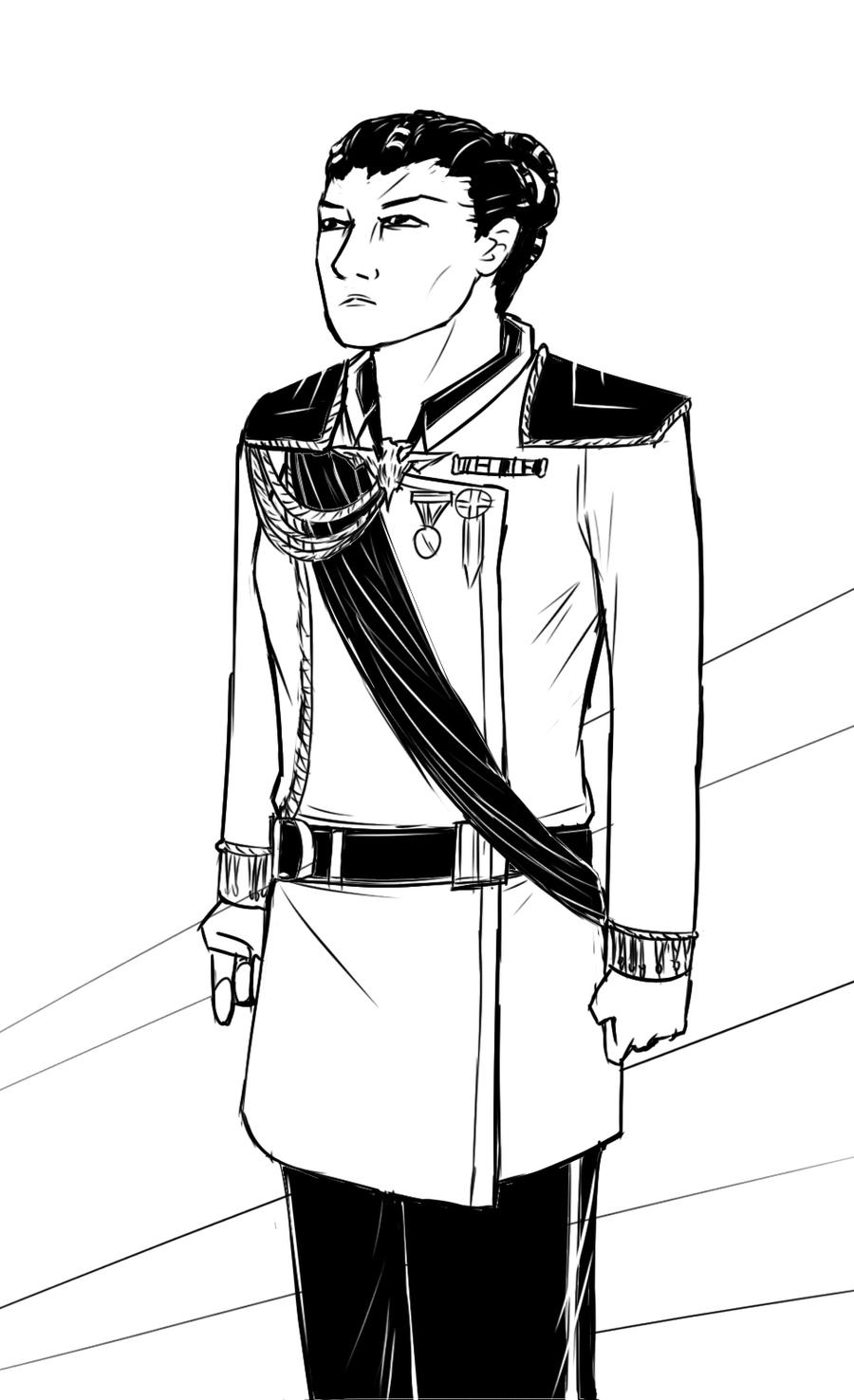
Officer XP Bank: This is a special bank only used for characters with the Promotion Motivation. XP from the Promotion Motivation goes into this bank instead of the main XP bank, and only these points may be spent to upgrade the Officer Quality (earn promotions). If the character does not seek a promotion, these points may be spent as standard XP.
Players cannot spend XP to bring either XP Bank value below zero. Since it’s possible to lose XP in other ways, however, the XP Bank value may occasionally go negative from other effects. If this happens, treat the character as if he has the Depression Quality; no XP will be gained from the Achievement Motivation until the character’s XP Bank is positive again. Since many characters gain XP primarily from the Achievement Motivation, this can be a very difficult hole to dig oneself out of; having a well-rounded character with many goals and Motivations makes this easier.
Choose Your Qualities
(For a list of Qualities, see Qualities on Qualities)
Qualities are particular quirks of your character that cause any number of good or bad effects in variety of tests and situations. Positive Qualities cost XP, while Negative Qualities give an XP bonus. They are best used to add flavor to a character while making playing the character a more unique experience.
You may take up to 60 XP worth of Positive Qualities at build time - others may be bought later. This limit does not include Genetic Qualities or the Officer Quality. Similarly, you may take up to 60 XP worth of Negative Qualities at build time. Although additional Negative Qualities may be taken later, those that are will typically be the result of aging, bad luck, or bad decisions, and do not earn an XP bonus.
If your character's Culture requires certain Qualities, they must be bought with XP (or grant an XP bonus) as normal.
Aspects of Qualities
Duration
Different Qualities last for different periods of time, ranging from weeks to generations. This should be considered the minimum duration. If you wish to keep a shorter-term Quality for longer, you may.
Temporary: This Quality is not inherent to the character and most likely will just exist for a short period of his life, often days or weeks.
Standard: This is an aspect that will last for a considerable amount of time, possibly but not necessarily permanently.
Lifetime: This Quality will be with the character all of his life. Usually this will be from birth, but sometimes it is the result of, for example, a permanent injury. These Qualities generally can never be removed and can only be added with explicit GM approval.
Hereditary: If a character with a hereditary Quality has children, this Quality is passed along. Similarly, a character cannot take a hereditary Quality unless one or more of his parents has it, or if he has used a genetic augmentation to add it.
Type
Mental: This Quality is based in the character’s mind somehow. This doesn’t mean it’s all in their imagination, but it is often a true psychological condition.
Physical: This Quality is based on a character’s physical body.
Social: This Quality is only a factor when the character is interacting with others.
Aging (special): This Quality, in addition to one of the other Qualities, means that this Quality is one that may be gained as the character ages. (See Determine Your Age on the online edition)
Choose Your Skills & Specializations
(See Skills on Skills)
Your character may have Skills purchased with XP. Skills begin at 0 and may be improved with XP at a cost of 20 XP per level. In addition, your character may have a number of Specializations in that Skill, which cost 10 XP each when bought at character creation. (It is much easier to earn Specializations in gameplay later, so for now, only learn the Specializations vital to your character's core abilities; see Learning from Failure on Gameplay.) Some Specializations have prerequisite Skills from lower Skill levels, which you must buy first. Each Specialization has a requisite level—the minimum rating that its parent Skill must be before the Specialization may be taken. For a list of Skills/Specializations and a guide on how they are used, see the Skills section.
If your character's Culture has requisite Skills, they must be paid for with XP.
Age and Skill Caps
Younger characters have not had the time or the maturity to delve deeply enough into a Skill to become true experts. There are four ages listed for each species: Puberty, Professional, Middle, and Old Age. Skill caps are determined based on these key ages. The Skill caps are listed in the Age Table above.
Learn Your Languages
(See Languages on the online edition)
Languages in Afterverse are treated like a tree and have four levels: World, Family, Language, and Dialect. New characters get one language (including dialect) for free, and any others must be bought with XP. For more information about the costs of languages, see the relevant section in the One Among the Crowd chapter.
Social Bank
(For rules on using the Social Bank, see Generic Contacts & the Social Bank on the online edition)
Your character has a "Social Bank" containing points determined by his CHA value. If your species has a racial modifier to the CHA Attribute, add that modifier × 10 to your Social Bank, but use the pre-modified value when looking up the table below.
CHA |
Social Bank |
|---|---|
| 6 | 80 |
| 5 | 65 |
| 4 | 40 |
| 3 | 25 |
| 2 | 15 |
| 1 | 5 |
These points may be simply banked for later use (strongly recommended for your first character), or they may be spent now on Featured Contacts and Subcultures. You may also freely transfer XP to this social bank for any reason.
Create Your Subcultures
(See Subcultures on the online edition)
Subcultures, which you come up with, are social groups that your character is a part of. Subcultures have a Reach (their power in the world), Rep (your reputation within the subCulture), and Qualities. Their cost is Rep × Reach + Qualities. This cost may come out of your Social Bank or from your XP, or any combination thereof. Subcultures are primarily useful for finding people, information, or gear. Many organizations and militaries have their own Subculture, which is included with the Officer quality.
See the One Among the Crowd chapter for more information on Subcultures and how they relate to contacts.
Create Your Featured Contacts (optional)
(See Featured Contacts on the online edition)
In addition to any Subcultures that your character is a part of, you may create a few Featured Contacts using your Social Bank points. These are important people in your character's life outside of the other player characters. If you are creating your first character, it's generally recommended to leave this alone; you'll be able to make new acquaintances during gameplay using your Social Bank (see Character Creation).
Contacts have Skills (generally up to rating 6) chosen from the same list of fourteen Skills you do. Contacts also have a Bond rating (1 through 6, with 1 being an acquaintance and 6 being a lifelong trusted friend), and a Favor rating, which represents who owes who a favor (negative means you owe them). Favor can be up to 1 less than Bond in either direction (so a Bond 4 contact may have a Favor of -3 to 3). Finally, contacts also have Contact Qualities which affect your relationship with the person. The total cost of a Contact is (Bond + Favor) × (Sum of all Skills) + (Sum of all Qualities).This cost may be spent from your Social Bank or from your XP.
Buy Your Gear, Vehicles, Augmentations
(For lists of gear, see the appropriate chapter in the Reference section on Tech and Gear. For further rules on acquiring and using gear, see Tech and Gear on Tech and Gear.)
The amount of money you may spend at character creation depends both on the Culture from which your character hails (as of the time of creation) and how many XP you invest in resources. Investing XP essentially buys a multiplier for the area’s Base Income. Your character's starting income is (XP × Base Income).
Once you have the amount of money desired, choose the gear you would like to purchase from the Gear chapter. Any money left over becomes your starting cash. Keep in mind, however, that purchasing items after character generation is subject to time spent and more risks so it’s worth it to buy more items at character creation rather than simply taking it as cash.
There is a limit to the Rarity that a character can get at character creation, which is based on your contacts and Subcultures. The Reach of any Subculture is used as the general limit—use whatever value is highest. If the character needs gear with higher rarity than can be obtained through Subcultures, a contact can be used; the contact's Influence Skill rating, or a Skill that is relevant to the item being acquired, may be used as the limit. For each item acquired this way at character creation, subtract 1 from the contact's Favor rating (after the XP has been spent to create the contact).
For any gear whose Rarity is above this limit, the player may spend 1 XP per Rarity point above the limit to buy that one item. Any groups of identical items (e.g. a rare kind of bullet) count as a single item for this purpose.